The Real Magic Behind Netflix’s ‘One Hundred Years of Solitude’
Netflix’s adaptation brings Gabriel García Márquez’s extraordinary world to the screen, where magical realism challenges the line between folklore and reality — and who gets to decide what’s real.
Story by Michele Roldán-Shaw
Photography by Netflix
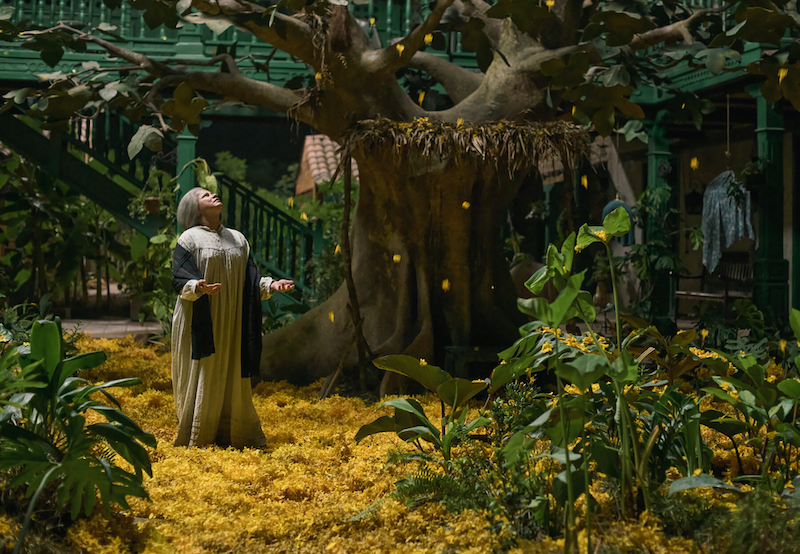
A cloud of yellow butterflies hovers around the head of a young man wherever he goes. A rain of tiny flowers descends from heaven when a patriarch dies. An entire town is stricken by a plague of insomnia that causes its residents to lose their memories. A trickle of blood rolls down the street, turning corners and entering the home of a mother to alert her that her son has died. A beautiful and saintly young woman ascends to heaven while hanging sheets on the line.
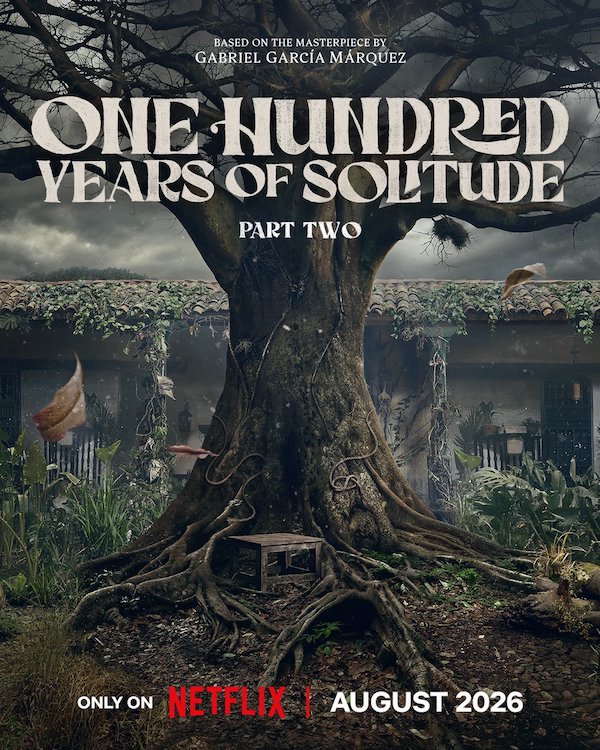
These are a few memorable moments in One Hundred Years of Solitude, the landmark 1967 novel by Colombian author Gabriel García Márquez, that has lately recaptured public imagination, thanks to a Netflix adaptation. As fantastic as the plot details may seem, Márquez famously insisted that his writing was rooted in real experience. “The truth is that there’s not a single line in all my work that does not have a basis in reality,” he told The Paris Review. “The problem is that Caribbean reality resembles the wildest imagination.”
Márquez is one of the most celebrated authors associated with magical realism, a literary mode that weaves extraordinary happenings into otherwise recognizable life and treats them as part of the natural order. Ghosts live among families. Prophecies govern fates. Time bends and circles back on itself. The wildness of the natural world spills into the apparent order of human society like jungle creepers overtaking an empty house. Unlike much fantasy, which establishes worlds with their own supernatural rules, magical realism often offers no explanation for the impossible. The miraculous simply happens, and the people experiencing it may accept it as readily as rain.
Magical realism became especially influential through the Latin American literary tradition, where writers used the form to explore histories, cultures and realities that did not always fit neatly within conventional Western ideas of realism. Some of its most famous works include “The House of the Spirits” by Isabel Allende, “Like Water for Chocolate” by Laura Esquivel, “The Lost Steps” by Alejo Carpentier and “Pedro Páramo” by Juan Rulfo.
Critics have interpreted magical realism in countless ways. Its impossible events can function as metaphor, expose the absurdity of supposedly rational societies or reflect histories so violent and surreal that conventional realism seems inadequate to describe them. The genre also can challenge assumptions about whose version of reality deserves to be treated as authoritative. Indigenous beliefs, folk traditions and perspectives marginalized under colonial rule may appear alongside Western ideas of history, religion and reason without being dismissed as inherently less valid.
But there is another, simpler way to look at it: What seems magical to people outside a culture may be perfectly ordinary to those within it, and vice versa.
Colombian author Ingrid Rojas Contreras explores that idea in The Man Who Could Move Clouds, her 2022 memoir about a family history filled with experiences that would be familiar to readers of magical realism: cursed treasures, healers, fortune tellers, ghosts and shape shifters. There are also kidnappings, killings, terrible accidents resulting in amnesia and the heavy burden of intergenerational trauma. The events of her family’s life can seem every bit as extraordinary as the experiences that outsiders might be tempted to classify as supernatural.
Toward the end of the book, Rojas Contreras reflects on how European colonization imposed definitions of what was real and what was not, what counted as history and what was dismissed as folklore, what qualified as religion and what was labeled superstition. In school she was taught that Jane Austen wrote realistic fiction, while Gabriel García Márquez wrote magical realism. Yet she observes, “Magical realism was just realism to us, and Jane Austen was not any life that was possible in our land.”
What we recognize as reality is also shaped by perspective. The categories used to describe it have historically reflected power: whose history was recorded, whose beliefs were legitimized and whose experiences were relegated to myth or superstition. Calling one worldview “real” and another “magical” can reveal as much about the person doing the labeling as it does about the world being described.
That distinction mattered to Márquez himself. In a 1980 interview with The Harvard Advocate, he was asked whether his work was influenced by folklore. He rejected the characterization but explained that he drew material from popular legends because people’s beliefs carry a reality of their own.
“I don’t know if it’s a reality or not that the dead sometimes come out of their tombs,” Márquez said, “but it’s a reality that people believe it. So what interests me is not whether it happens, but the fact that some people believe it does. And if you just add up these beliefs you can create a whole new universe.”