Tree talk with Michael Murphy: Crape murder or just a case of crape mayhem?
Story by Carolyn Males
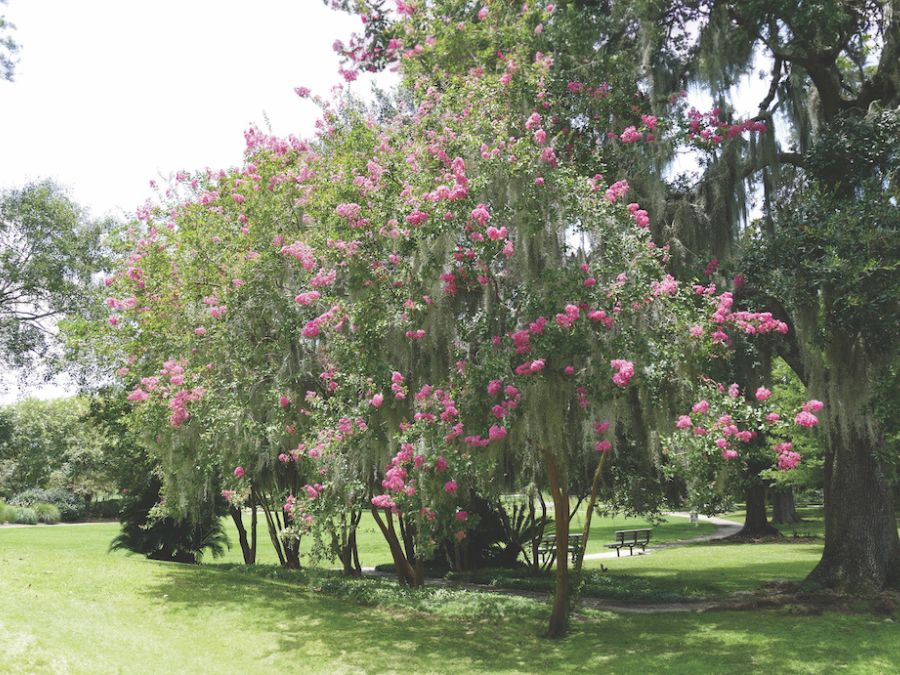
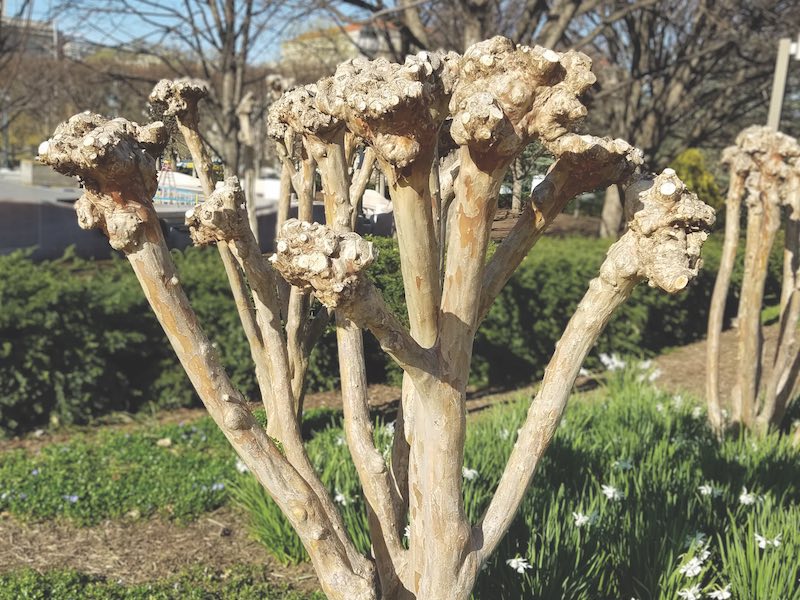
If pruning back every crape myrtle, come winter, is an offense against nature, then my neighborhood dotted with these naked topless sticks is a crime scene. Yet by late spring, these “victims” of “crape murder” are festooned with flowers. What’s more, a few streets over a friend’s front yard is graced by a tall crape myrtle that reaches skyward. It clearly has not been topped off in years, if at all, and come May, it too sports blooms. I had to wonder: is the much-ballyhooed subject of crape murder really a thing?
So, as always, I turn to master arborist Michael Murphy to get the lowdown. But before investigating further, I gather a few facts: The deciduous Lagerstroemia indica or crape myrtle, prized for its delicate papery blossoms and variegated peeling bark, originated in India. Older varieties were tall, but today’s crape myrtles, developed over the past few decades, come in a variety of pinks, reds, purples, lavenders and whites, with sizes ranging from 1-foot dwarfs to 25-foot or more giants. Here in the Lowcountry this sun-loving plant flowers from May or June through fall.
But to prune or not to prune? That is the question, or at least it was one of many, I posed to Murphy as we met once again, this time at the cross-section of two residential streets in Beaufort. To our backs, massive old crape myrtles stood along the rim of a pumping station site, hiding it from view. And that’s not a bad thing. But Murphy tells me, this same variety of crape myrtles once lined the sidewalk in front of the houses across the way where they persistently threatened to pull down overhead power lines. In response, the power company would chop away at them, only to have the recalcitrant and unruly reprobates sprout back up. Then in 2017, with a grant from Palmetto Pride, an organization dedicated to beautifying South Carolina, a cooperative effort of residents along with city and other local entities, undertook a replanting project, replacing these obstinate offenders with a lower-growing variety. The result? A lovely pink line of blooms along the street in warmer months and sculptural silhouettes of exfoliating bark in winter. And no more worry about power outages or pruning.
[LOCAL Life] Crape myrtles are a popular landscaping element here. What makes them a good choice for the Lowcountry? [Michael Murphy] People like the beauty of their flowers and the ease of growth and that they don’t have to pay attention to them. Crape myrtles are very durable. They’re super drought tolerant so after a tree is established, you don’t have to water it anymore. And unlike live oaks, they’re saltwater tolerant. Plus they never die back from winter cold here.
[LL] What about problems like aphids and powdery mildew? [MM] Back in the late ’70s and ’80s, the National Arboretum developed new varieties. The ones that have Native American names, like Catawba, Hopi and Manhattan were developed to be resistant to powdery mildew that forms white crust on leaves. Aphids, on the other hand, suck sap from plants, and their sticky excrement creates a sooty mold. Aphids can be sprayed for, but powdery mildew (in non-resistant varieties) is a problem because you can’t spray to get rid of a fungus, only to prevent it.
[LL] You’ve said that the crape myrtle is one of the most misunderstood trees. So is Crape murder, cutting these trees back each year, a criminal offense? [MM] Crape murder is not real. That’s because they’re durable and don’t have the response that most trees have when you do improper pruning. For example, if you cut back any other trees, there will be a lot of decay. Crape myrtles, on the other hand, can push out new growth with very little decay in the branches. So cutting it back doesn’t really kill the tree. The new growth comes, and you get flowers. So all unnecessary pruning is really more like crape mayhem.
[LL] Crape mayhem? [MM] It’s more a visual. Nobody wants to see that happen to a tree. And it’s unnecessary. In many cases the reason people cut them back is because a big tree was planted in a space that was wrong for it. Years ago we didn’t have choices. The right species was put there, but it was the wrong size tree.
[LL] So if it’s a tree that’s the right size for its space, why do people automatically keep cutting them back each winter? Is that where the mayhem comes in? [MM] Some landscapers thought that if you didn’t cut crape myrtles back, they wouldn’t flower, so they started putting heavy pruning into their winter maintenance program. But that’s just not true. We have crape myrtles in our community that were never pruned and always flower. They have grown out to their size and are never going to get any taller. They were chosen properly for their site.
[LL] So crape mayhem is a copycat thing? [MM] Yes, there’s always someone on the block that people look to and that you think knows more than you. Sometimes people see landscapers doing it, so they think it’s the thing to do.
[LL] So you espouse a “right tree, right place” philosophy.
[MM] Yes, crape myrtles are a perfect tree for this because they are propagated to grow into five different sizes: very dwarf (1-3 feet tall), dwarf (3-6 feet tall), semi-dwarf (5-13 feet), small tree (10 to 20 feet) and regular tree (20 feet and taller.) The first four are good choices because they would fit into most landscaping designs. The largest growing tree, in most cases, can be too large for many sites. Unfortunately, many homeowners and landscapers choose them because they’re more readily available, and they don’t realize how tall they’ll get. Remember: all the trees might look the same size at the nursery when they are small. So the best practice is to research before you buy, and note at what size the variety you’re considering will mature to.
[LL] Let’s say you have a crape myrtle that you love but that’s too tall for a particular spot. How easy is it to transplant it somewhere else? [MM] Their roots are very fibrous and dense, so it’s easy to pick it up and move it as long as you get the proper root ball size. And the roots are not invasive, so they won’t lift concrete if you’re planting it near a driveway or sidewalk. But because their roots are dense and thirsty, the one thing you can’t do is plant underneath crape myrtles.
[LL] I see there are single and multiple trunk varieties.
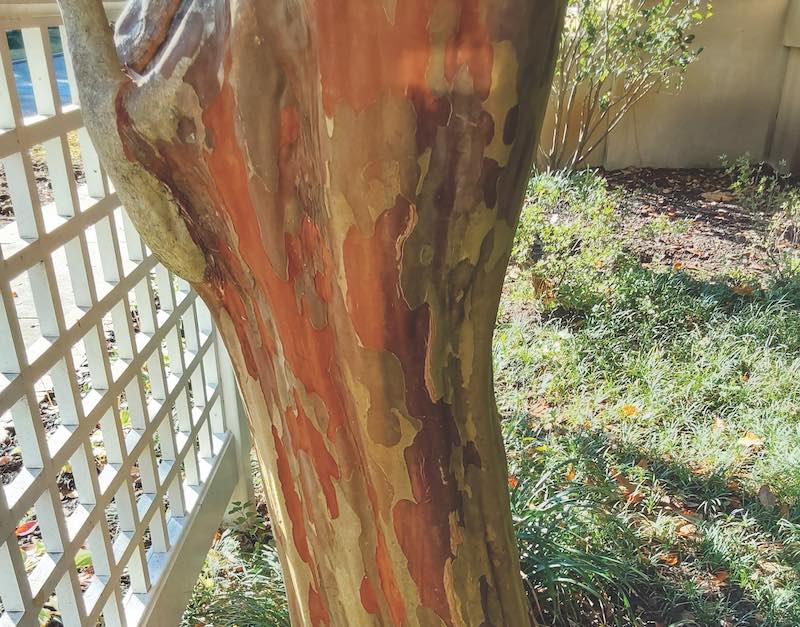
[MM] At my house I chose single-trunk Natchez crape myrtles for their trunk effect. This particular type of plant has a cinnamon bark that peels off or exfoliates every year. It looks like a palomino pony. I have a lot of trees on my property, so there’s a lot of shade, and I don’t really see the flowers until they fall on the ground. The National Arboretum developed most of their species for their bark features so that when they lose their leaves, they have this beautiful winter silhouette.