The Truth About the Lowcountry’s Most Misunderstood Predators
As alligator sightings increase with the warming weather, a marine biologist unpacks their behavior, common myths and how locals can safely coexist.
Story by Bailey Gilliam
Photography by Arno Dimmling & Jeff Kramer Photography
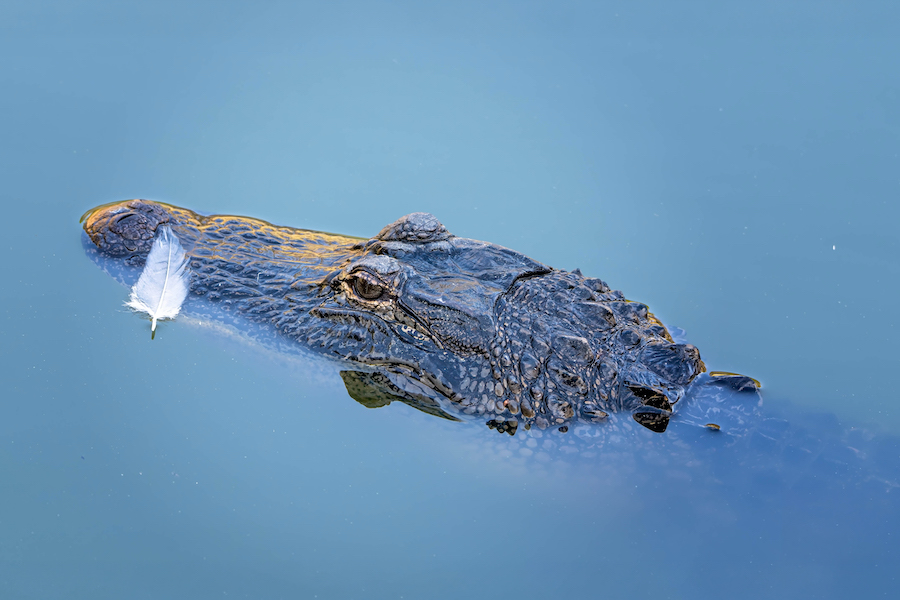
Spring in the Lowcountry means azaleas, pollen, warmer tides and the annual reminder that we share this place with dinosaurs. Alligators here are not rare visitors. They are permanent residents, and understanding how they behave is the key to living safely beside them.
As temperatures climb, sightings naturally follow. A slow glide across a lagoon. A surprise crossing on a golf- cart path. A social media post that starts with, “You won’t believe what was behind my house this morning.” Sightings may feel sudden, but the behavior behind them rarely is.
For many residents the reaction is immediate concern. But according to marine biologist Amber Kuehn, most of the fear surrounding alligators isn’t rooted in facts. It’s rooted in misunderstanding. Alligators follow predictable seasonal patterns, especially in spring. Understanding those patterns replaces assumption with science.
Protected, not persecuted
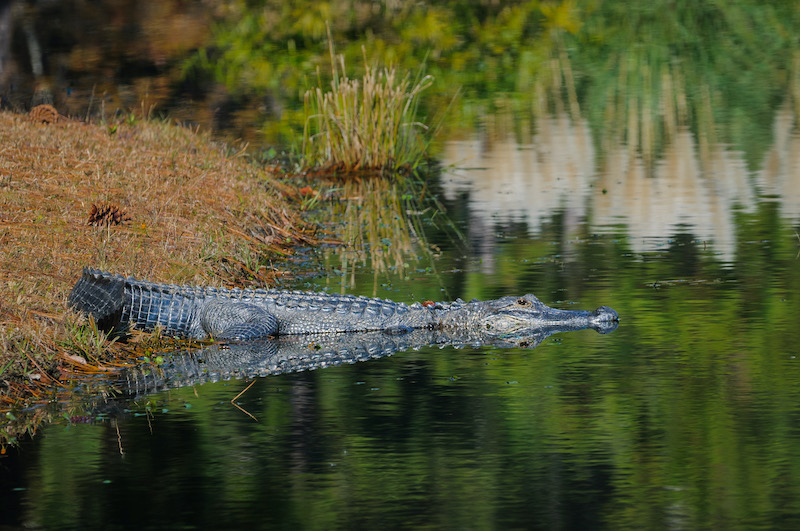
American alligators are protected under federal law. It is illegal and dangerous to feed, entice, harass or kill one.
“They are protected because of their similarity in appearance to the American crocodile,” Kuehn explains. “They are both protected because the crocodile is endangered, and in the Florida Everglades they live alongside alligators.”
Although alligators recovered from heavy overhunting in the 1950s and ‘60s and are no longer endangered, federal protections remain in place to prevent accidental harm to the endangered crocodile. There are no crocodiles in the Lowcountry, but the law applies nationwide. That reality makes managing populations and dealing with so-called nuisance alligators more complicated than many people realize.
What makes a nuisance alligator
So what actually turns an alligator into a nuisance?
According to the S.C. Department of Natural Resources, it is not simply one that appears near people. A nuisance alligator is one that has lost its natural fear of humans — often because it has been fed — and may pose a threat to people or property; or it has become trapped somewhere it does not belong.
“You always hear, ‘a fed alligator is a dead alligator,’” Kuehn says. “But any interaction makes them familiar.”
Even tossing fish scraps into the water can teach an alligator to associate humans with food. Once conditioned this way, wildlife officials warn, alligators may begin approaching people, expecting a meal. That behavior almost always leads to the animal being euthanized.
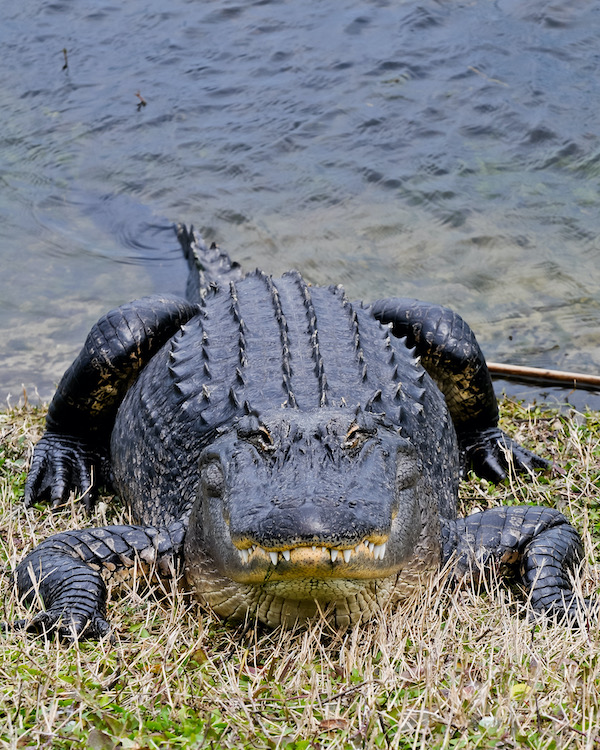
Actual attacks on humans remain extremely rare. Since 2000 South Carolina has recorded only about two dozen incidents, despite a population of more than 100,000 alligators statewide. Pets, however, are taken far more often. Dogs near the shoreline can resemble natural prey, which is why keeping pets leashed and away from pond edges is one of the most important safety rules here.
Relocation is rarely a solution. Alligators have strong homing instincts and may travel miles, crossing highways and neighborhoods, to return to familiar territory. Moving them elsewhere also can trigger territorial fights, spread parasites or disease, and remove breeding animals from the population.
Simply seeing an alligator in your yard, neighborhood, on the beach or even briefly in the ocean does not make it a nuisance. Most of the time, it is simply passing through.
Why spring means more movement
Spring movement is largely driven by mating season.
“Obviously they are in freshwater,” Kuehn says. “They can go in salt water, but they can’t live there.”
A common myth claims alligators enter saltwater to remove algae from their backs.
“A lot of people have heard that, but it’s not true,” she says.
During mating season, males travel in search of territory and opportunity.
“They have to migrate to mate. They have to leave the pond they are inhabiting so they don’t get killed by the alpha male,” Kuehn explains. “The alpha male alerts all the males that they have to leave because the females belong to him. They fight over females if one refuses to leave. That’s when you hear that bellow during mating season. The male is enforcing his territory.”
Traveling between freshwater ponds often requires crossing brackish creeks and sometimes even stretches of shoreline. When alligators appear on the beach, wildlife officials note they are typically using the coast as a highway between freshwater habitats.
If one is spotted on the roadside and not obstructing traffic, the best course of action is simple: leave it alone. It will almost always move on.
Nesting season and protective mothers
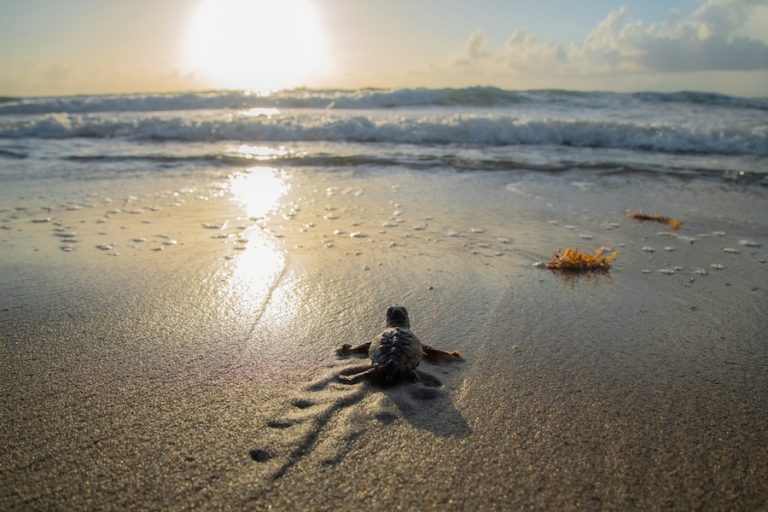
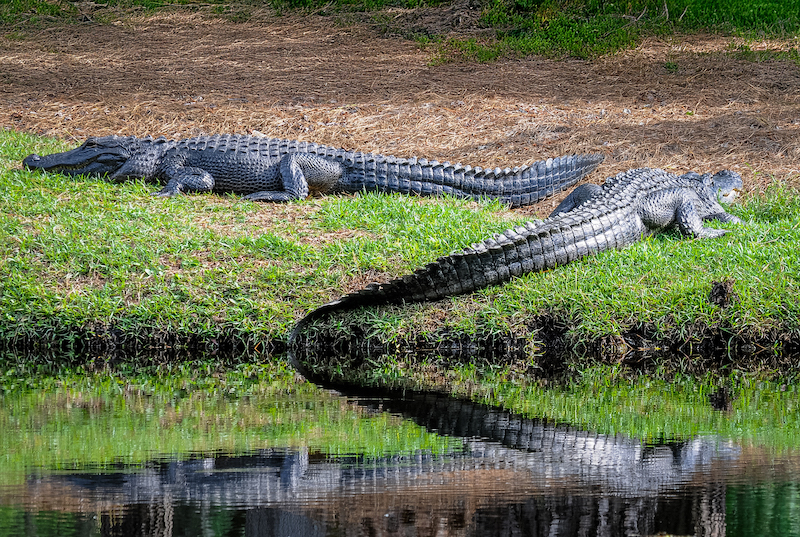
Spring also brings nesting season. Alligators lay eggs on land, and like sea turtles, the temperature of the nest determines the sex of the hatchlings.
“Warmer incubation produces males, and colder, females,” Kuehn notes. “Sea turtles are the opposite.”
Once hatched, the babies remain near their mother for up to two years.
“They are an ancient reptile that has not lost their maternal instinct,” Kuehn says. “The mother is very protective of the young because the male will eat the hatchlings.”
If you hear chirping near the water’s edge, leave immediately. The sound can resemble birds or crickets, but near a lagoon it is a warning. Hatchlings are nearby, and a defensive mother likely is too.
The freshwater edges around us are where alligators live, mate and raise their young. They are not intruding. They are simply carrying out their life cycle beside us.
How development reshaped their habitat
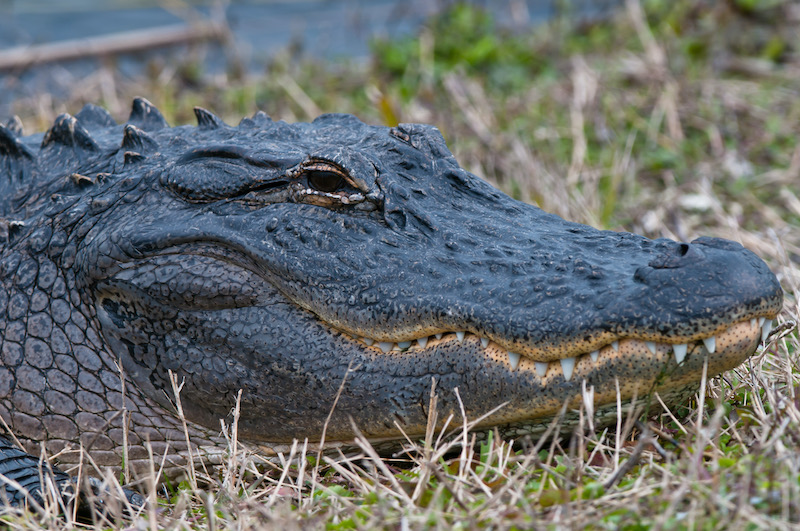
If alligators seem to show up in our neighborhoods, it’s largely because those neighborhoods were built where their wetlands once stood.
“Ponds and lagoons — we don’t have them. They are all man made. It’s not their natural habitat,” Kuehn says.
Historically, alligators occupied vast wetlands once known as the Great Swamp, most of which now lies beneath Sun City Hilton Head.
“Developers filled in a swamp and ejected alligators from their natural habitat,” Kuehn said.
Today’s retention ponds were engineered for flood control, not habitat.
“The reason retention ponds are there is so properties don’t get flooded,” Kuen explains. “It’s to redirect water so it doesn’t flood your house. The alligators had to go somewhere.”
Wherever freshwater exists, they persist.
What they actually eat
Their diet depends largely on size. Alligators eat frogs, snakes, turtles, fish, crabs, raccoons, opossums, wading birds and occasionally deer, even smaller alligators. In healthy ecosystems, fish are preferred prey. But in manmade ponds with limited circulation, biodiversity suffers.
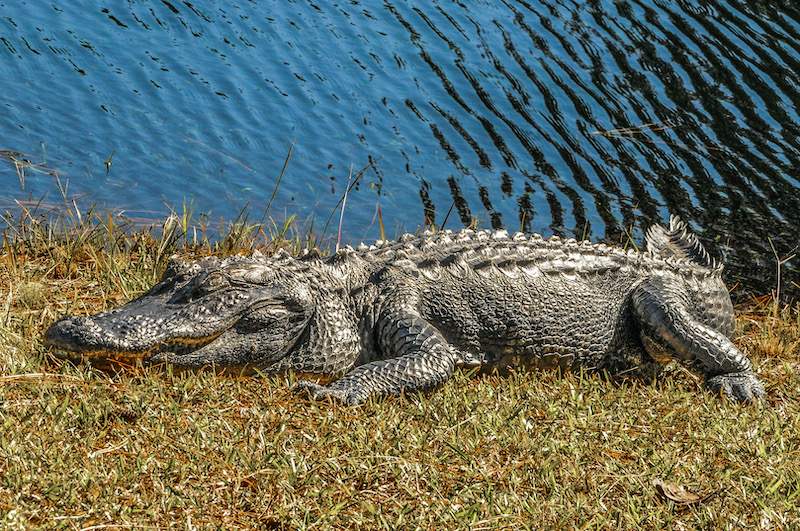
“They’d prefer fish, but when you have a man-made pond with no circulation, the fish will die,” Kuehn says.
Herbicides applied to remove algae further weaken the food chain.
“The algae supports the fish. And if there are no fish, what are they going to eat? Something in their size range at the edge of the pond.”
It is opportunistic behavior, not aggression.
Living safely alongside alligators
Living alongside these ancient reptiles ultimately comes down to awareness. Keep pets leashed and away from pond edges. Teach children basic water safety. Remember that alligators are ambush predators.
“If they’re going to hunt something that’s on land, they will be in the water with their eyes looking out,” Kuehn says. “If something comes into the edge of the water, they will lunge and drag it in. They don’t do that because they’re mean. That’s just how they hunt.”
Even bending down to retrieve a golf ball can make you appear smaller.
“If you’re going near a pond, you’re putting yourself in a situation that’s not good,” she says.
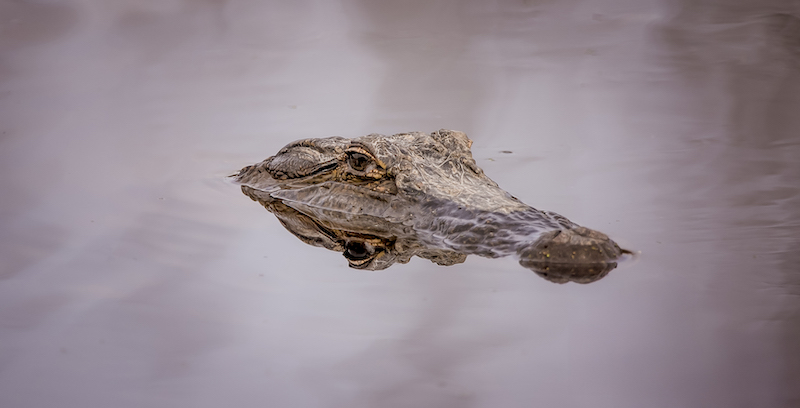
Wildlife officials reinforce that alligators do not hunt people on land. When out of the water, they are usually basking or traveling. If encountered, back away slowly and give the animal space.
In the Lowcountry, living with alligators isn’t about fear. It’s about understanding the landscape we chose to share with them