Midnight in the Garden of Good and Evil: How One Murder Put Savannah in the Spotlight
A murder, a manuscript and the moment Savannah became a cultural phenomenon
Story by Carolyn Males
When Midnight Came to Savannah

Shaded by magnificent live oaks, this beautiful square, with an obelisk commemorating Revolutionary War hero Casimir Pulaski, is framed by elegant homes, including the Mercer House, which takes up a full city block. Location: Bull, Monterey and Wayne streets 
The old Candler hospital, named after Methodist Bishop Warren A. Candler, housed the emergency room where Danny Hansford and Jim Williams were taken after the shooting and the morgue where Danny’s body was sent. It now houses the SCAD Deloitte Foundry. Location: 516 Drayton 
Midnight fans leave tokens — a beer can, matchbox cars resembling Danny’s prized black car, blue glass beads and other memorabilia on his grave marker in Greenwich Cemetery, near Bonaventure, its larger and more famous neighbor. Location: 330 Bonaventure Road/Greenwich Avenue 
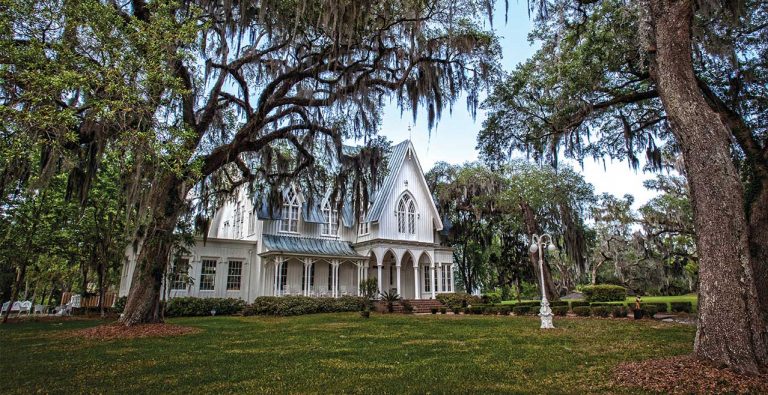
The Civil War delayed the completion of this block-long mansion that was started for Hugh W. Mercer, songwriter Johnny Mercer’s great-grandfather, who would never live there. Completed in 1868, the grand Italianate home would serve as a residence for a cotton merchant and, in the mid-20th century, as a temple for the Shriners before Jim Williams restored it and filled it with beautiful antiques. Today, it’s a museum. Location: 429 Bull St. 
The Italianate Renaissance Revival palazzo, built for a shipping magnate in 1919, was once owned by Jim Williams and housed his antique show before he sold it to a law firm. It would appear in both the 1962 movie Cape Fear starring Robert Mitchum and in the 1997 Midnight movie as Sonny Seiler’s real-life law office. Location: 447 Bull St. 
This elegant 1873 mansion (now a luxurious inn) on Lafayette Square is where Joe Odom once lived and threw his boozy raucous parties. Location: 330 Abercorn 
Live oaks, palms and statuary grace this scenic burial place on the Wilmington River, which holds the graves of Johnny Mercer, Conrad Aiken and other local notables. Midnight fans still swarm over the burial site where the Bird Girl sculpture by Sylvia Shaw Judson once stood. The family that owned the plot gifted the iconic statue to the Telfair Museum, where it can be viewed today. Location: 330 Bonaventure Road 
The backdrop for some of Midnight’s colorful characters, even today is this 123-year-old eatery is where Savannahians still get their eggs or burgers along with doses of gossip. Location: 404 Abercorn St.
The crime:
A waning crescent moon hung in the sky over Savannah the night Danny Hansford was shot. That slice of moon, traditionally associated with new beginnings, would for the 21-year-old street hustler mean death — a transition to whatever afterlife awaited him. And while those bullets that entered his chest, head and back might have been just facts written up in a coroner’s report leading to the arrest of the perpetrator, in this case it sparked a series of events that would, a decade later, put this quiet city in the national spotlight.
The trigger for the resulting seismic shift in tourism was Midnight in the Garden of Good and Evil, a 1994 “nonfiction novel” (a la Truman Capote’s In Cold Blood) that centered on that very murder with some re-creations of conversations and events, with a few embellishments and pseudonyms thrown in. It would capture the attention of non-local folks who’d only seen Savannah, if they’d seen it at all, as a quick detour on the way to Florida. Three years later, a Hollywood movie of this bestseller, directed by Clint Eastwood, would bring in new waves of fans.
In the wee hours of that May 1981 morning, after Jim Williams fired his German Luger at Hansford, his young employee and sometime lover, he had finally called the police. Soon the front of Williams’s grand brick mansion and Monterey Square, that it sat across from, would be ablaze with the flashing lights of patrol cars and emergency vehicles. Inside, the scene of the crime revealed an 18th-century grandfather clock knocked over in the hallway leading to the study where Danny’s body, one hand cupped around a pistol, lay face down on a Persian carpet. Williams, the city’s premier antiques dealer, renowned for restoring 50 or so historic Savannah houses and for throwing the city’s “must be seen at” Christmas bash, admitted he’d delivered the fatal shots after Danny, fueled by alcohol and drugs, had gone on a violent rampage. “Self-defense” Williams would plea, pointing to a series of bullet holes embedded in the floor and Williams’s desk and chair — shots he alleged that were fired by his young lover.
Meanwhile, a quarter of a mile away just across from Forsythe Park, Dr. David Dorsner had been patching up the sick and wounded who’d come through the emergency entrance of Candler Hospital. When the body of a muscular young blond man with bullet wounds arrived on a gurney, the doctor followed standard procedure, examining and certifying his death before sending it to the morgue’s freezer. Sometime later, the police brought in the suspect, a mustachioed 50-ish man, for a medical check before he was taken to the lockup. For Dorsner, who would later found Hilton Head Island’s first urgent care clinic, it was just a routine night in the ER in an era when many of the city’s old buildings still wore gritty faces, and corpses showing up wasn’t unusual. “In downtown Savannah ‘the knife and gun’ club used to be there — that’s an idiom for people who liked to shoot and stab each other,” he says with dark humor. Little did Dorsner know that on that particular night the actions of one of his nurses would later provide a possible defense that could save the mustachioed suspect he’d checked out. She had noticed that Danny’s hands, which should have been wrapped in paper bags at the crime scene, were bare. So she encased them in plastic — a solid no-no for preserving any gunshot residue that would have been there had Danny fired at Williams first.
The waning moon that night would portend Georgia’s longest running legal battle — four trials, two resulting in guilty verdicts, one mistrial, and finally, in 1989, an acquittal. While the first three trials took place in Savannah, where they were hotly followed. The last was moved to Augusta, where no one seemed to know or care about the case. At this final trial, like the others, the prosecutor Spencer Lawton Jr. claimed that Williams had staged the death scene to make it look like self-defense, firing holes in the wall and placing the gun under Danny’s dead fingers. Williams’s lawyer, the colorful Sonny Seiler, (noted for owning a series of University of Georgia bulldog mascots — all named Uga) decried “the sloppy crime-scene work.” The failure to bag Danny’s hands at the scene, he noted, meant any hard evidence to prove Danny had fired off shots at his lover might have been lost. The antique dealer’s celebratory victory, however, was short-lived. A few months later, on the way to feed his pet cat, he dropped dead in the study where Danny drew his last breath. Cause of death: heart failure and pneumonia.
The book
How does a book help change a city’s fortune? Obviously, there were many other forces at work that brought about the city’s renaissance. But one March day, a year or so later when Berendt, a New York magazine writer and editor, stepped into the warm Savannah sunlight, he’d immediately become intoxicated by the city’s beauty, its culture, and, yes, its colorful collection of eccentrics. Later he would rent a place downtown and stay on, befriending Jim Williams and an assortment of the city’s blue bloods, entertainers and amusing oddballs.
Who can forget Luther Diggers sitting at Clary’s counter, contemplating his breakfast as flies he’d glued to strings circled his head and a vial of poison (enough to poison the city’s water supply) sat tucked in his pocket? And oh, the music! Miss Emma Kelly, lady of 6,000 songs, answering requests on her piano at her namesake club until the financial shenanigans of her partner, slipshod lawyer Joe Odom, brought the club to financial ruin. What’s more, when that genial legal reprobate wasn’t kiting checks or skipping out on rent, he was hosting round-the-clock, open-door parties where folks could drop in to hear him tickle the ivories and then duck into the kitchen to be coifed by a stylist stationed among the pots and pans.
Meantime, as all this and the trial progressed, the uber-extroverted Lady Chablis, a female impersonator, would sashay her way through the action.
But it was Minerva, the Gullah-Geechee conjure woman, whose ministrations influenced the book’s title. Berendt would accompany Williams and Minerva to a graveyard, where she would perform rites over the grave of Dr. Buzzard, the legendary Gullah-Geechee root doctor. Fifteen minutes before midnight would be the time to do good. Then at the stroke of midnight the next 15 would be for consorting with evil. Armed with herbs, graveyard dirt and an array of rituals, Minerva, her eyes shielded by purple-lensed glasses, would “chew the root,” exerting her spiritual influence over courtroom proceedings.
The resulting bestseller, Midnight in the Garden of Good and Evil, has often been called “a love letter to Savannah.” Berendt’s vast canvas of quirky characters, framed by live oaks dripping with Spanish moss, perfumed by magnolias and fueled by mint juleps, is infused with affection. Throw in that touch of Hoodoo with native son Johnny Mercer’s songs as background music, and there’s plenty of Southern Gothic to keep one turning pages. And readers did. The book sat on the New York Times bestseller list for a record-breaking four years. Bus tours based on “The Book” would cruise Savannah streets, and fans would roam from site to site, the book with its iconic cover of the Bird Girl statue in Bonaventure Cemetery tucked under their arms.
Clint Eastwood comes to town
It’s 1997 and it’s not unusual to spot director Clint Eastwood in and around Bull Street and beyond. Savannahians may have enjoyed bumping into Tinseltown royalty at the time, but avid fans of Berendt’s Midnight would decry its Hollywoodization of the town.
Shoehorning the action of a 338-page book, especially one that encompasses a cityscape of characters and plot, as did Midnight, into a two-hour movie is no easy task. In the end, some characters faded in and out. Lady Chablis would become a major scene stealer, showing up both in places she had actually been (like crashing the Black debutante ball), but also strutting into places she hadn’t been (like in the witness box at Williams’s trial).
The timeline too would be flattened and distorted. Unlike the author who’d come to Savannah on the heels of the second trial, John Cusack, playing the Berendt-based character, would arrive in town in time to attend Williams’s Christmas gala, and Danny would meet his untimely fate that very same night after the festivities had ended.
In the aftermath, the reporter would form a romantic attachment with one of Joe Odom’s ill-fated nightclub business partners, played by Clint Eastwood’s daughter Allison. As for Williams? Kevin Spacey portrayed him as suave and smart (but perhaps a bit more subdued than the real-life antiques dealer) who kills a very photogenic Danny (Jude Law). And, happily for the movie Williams, he got a much speedier acquittal when the real-life four trials were collapsed into one.