


After 13 Years, a Right Whale Returns With a New Calf
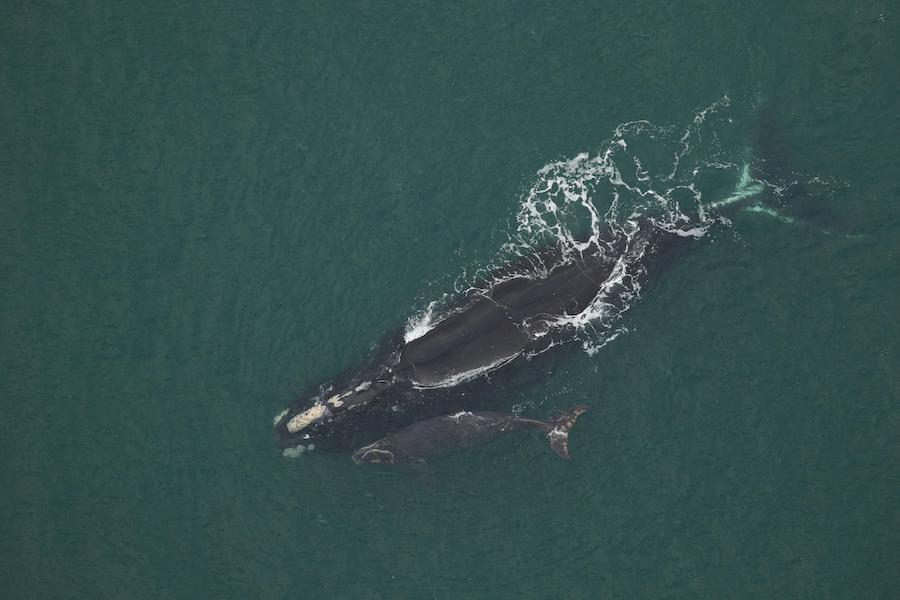
Thirteen years after her last documented calf, a North Atlantic right whale named Uca surfaced off Hilton Head Island with a newborn at her side. For scientists tracking the species’ uncertain future, the sighting was more than a welcome surprise.
Story by Bailey Gilliam
On Dec. 23, 2025, an aerial survey team spotted something extraordinary about 15 miles east of Hilton Head Island: a North Atlantic right whale named Uca, swimming alongside her newborn calf. Uca, named for the fiddler crab because of the uneven white markings on her head, had survived multiple fishing-gear entanglements. She hadn’t been seen with a calf in 13 years. Her first known offspring, born in 2012, had disappeared and was presumed dead. Now at least 23 years old, Uca is a mother again.
Researchers with Clearwater Marine Aquarium Research Institute documented the sighting during their annual monitoring of one of the world’s most endangered large whale species. According to the National Oceanic and Atmospheric Administration (NOAA), only about 380 North Atlantic right whales remain, including roughly 70 reproductively active females. Uca’s newborn was among 23 calves documented during the 2025-26 calving season, the highest number since 2009. For a species struggling to survive, every calf counts.
A nursery off our coast
Each fall North Atlantic right whales travel south from feeding grounds off New England and Canada to the warmer waters of the Southeast. From November through April the coastline from North Carolina to Florida becomes the species’ only known regular calving and nursery area. Georgia and northeastern Florida are the heart of the calving grounds, but South Carolina’s waters also provide important habitat. The region’s relatively warm, shallow coastal waters offer mothers and newborns a place to nurse and gain strength before migrating north. NOAA has designated coastal waters from Cape Fear, North Carolina, to below Cape Canaveral, Florida, as critical habitat for the species.
These giants can grow more than 50 feet long and weigh up to 70 tons. Despite their size, they survive on tiny crustaceans called copepods, filtering them from seawater through comb-like plates of baleen. Right whales are recognizable by their broad backs without dorsal fins, V-shaped spouts and rough patches of skin called callosities. Each whale’s pattern is unique, allowing researchers to identify individuals and follow their lives for decades.
Every calf counts
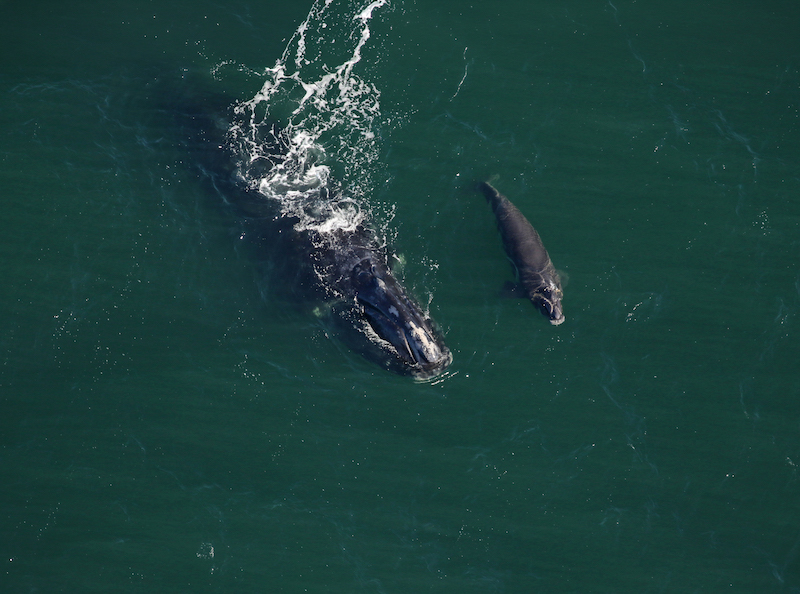
After a pregnancy lasting more than a year, a female gives birth to a single calf measuring approximately 14 feet long. The newborn stays close to its mother, nursing and gaining strength for the long migration north. Healthy females can give birth every three to four years, but injuries, food shortages and other stresses have stretched that interval to seven to 10 years for many whales. That makes the latest calving season particularly encouraging. Researchers at the New England Aquarium found that 18 of the returning mothers documented during the 2025-26 season had given birth within the previous six years, suggesting some females may be recovering their reproductive health.
“Many of this year’s moms have had shorter intervals,” said Amy Warren, scientific program officer at the aquarium’s Anderson Cabot Center for Ocean Life, in an April 2026 report. She noted that the trend offers hope for healthier mothers and faster population growth. Still, recovery remains fragile. The modest population gains of recent years leave the species dangerously close to extinction.
Trouble in the water
North Atlantic right whales earned their name during the commercial whaling era, when hunters considered them the “right” whales to kill. They swam slowly, remained close to shore and often floated after death. Commercial whaling has ended, but modern dangers remain. According to NOAA, more than 85% of right whales have experienced fishing-gear entanglement. Ropes can wrap around their flippers, tails and mouths, causing injuries that make swimming, feeding and reproducing more difficult.
Vessel strikes pose another serious threat, especially to mothers and calves spending time near the surface. Warming oceans also shift the distribution of copepods, sometimes forcing whales into unfamiliar waters with additional hazards. With so few breeding females remaining, the loss of even one mother can affect generations of future calves.
A fighting chance
Scientists, conservation organizations and fishermen are developing ways to make the ocean safer. New fishing technology allows crews to retrieve traps without leaving ropes suspended in the water, reducing one of the greatest threats to right whales. Vessel-speed restrictions also help prevent deadly collisions. Federal rules generally require vessels 65 feet or longer to travel at 10 knots or less in designated seasonal management areas, while smaller boats are encouraged to slow down wherever whales may be present. Meanwhile, aerial surveys, underwater listening devices and photographic identification help researchers monitor whale movements, injuries and family histories.
Along the southeastern coast, those efforts help scientists track mothers and newborns, monitor population trends and identify where additional protections may be needed. Uca’s story captures both the promise and uncertainty. After years of setbacks, she returned to the waters off Hilton Head with a newborn at her side. For a species fighting for survival, the next generation is already swimming among us.
How can you help
Keep your distance. Federal law generally prohibits approaching within 500 yards of a North Atlantic right whale. If one surfaces nearby, slow down, avoid sudden maneuvers, and leave the area at a safe speed.
Slow down. Travel at 10 knots or less where right whales may be present. Most vessels 65 feet or longer must obey seasonal federal speed restrictions in designated areas.
Report sightings. Call 877-WHALE-HELP (877-942-5343), or use the Whale Alert app. Provide the location, time and number of whales observed.
Leave rescues to experts. Never approach or attempt to free an injured or entangled whale. Report it immediately so trained responders can help.
Protect their habitat. Dispose of fishing line and marine debris properly, check NOAA’s current whale advisories, and support conservation efforts.
Whale Week 2026 (Nov. 30-Dec. 5)
Right Whale to Save Festival
When: 10 a.m.-1 p.m., Dec. 5
Where: Forsyth Park, Savannah
Details: Celebrate North Atlantic right whales with a week of free, family-friendly activities, including trivia, bingo, educational programs and a marine science panel. The festivities conclude with the Right Whale to Save Festival at Forsyth Park, featuring live music, food trucks, games and more. tybeemarinescience.org/whale-week


