A New Deep-Sea Coral Species Named After a USCB Marine Biologist
Dr. Mercer Brugler’s pioneering research on black coral genetics and evolution is honored with the discovery of Leiopathes brugleri, a species found in deep waters between Texas and Florida and around the Azores.
Story + Photography by Carol Weir
For most scientists, having a species named in their honor represents the pinnacle of a career — and usually it occurs after they’re gone.
“Mostly, this happens when you’re dead,” Dr. Mercer R. Brugler said with a laugh. “When I got the news, I had to check to make sure I was still here.”
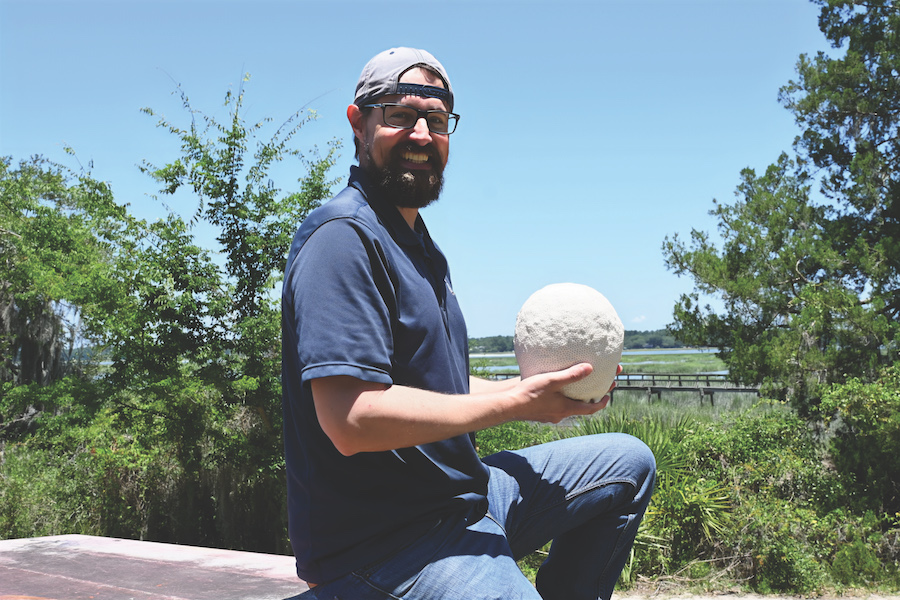
Fortunately for Brugler, chair of the University of South Carolina Beaufort’s Department of Natural Sciences and professor of marine biology, he is very much alive to celebrate the distinction.
Recognizing Brugler’s pioneering contributions to the study of black coral genetics and evolution, scientists recently named a new species after him. A team from the Smithsonian National Museum of Natural History and international collaborators published their discovery of the deep-sea black coral Leiopathes brugleri on June 15, 2026, in the peer-reviewed journal, Coral Reefs.
The honor caps more than two decades of research devoted to understanding some of the ocean’s oldest and least understood animals.
“When they called me to tell me, I felt flabbergasted, stunned and thrilled,” Brugler said.
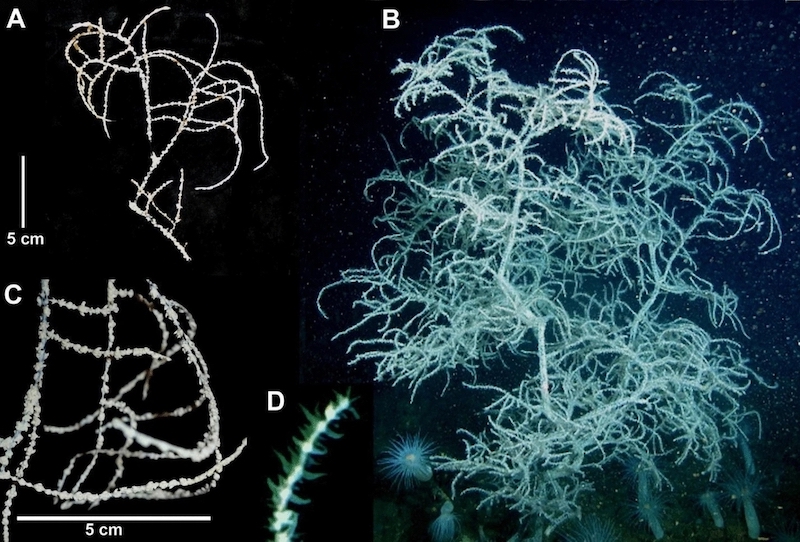
The newly described species was discovered on continental slope habitats between Texas and Florida and in the waters surrounding the Azores at depths of 244 to 488 meters.
The coral forms large, bushy colonies exceeding 2 meters in height and width, providing habitat for thousands of marine species. Scientists have documented that these slow-growing corals can live for more than 4,265 years, making them among the oldest living animals on Earth and important indicators of long-term ocean health.
“Black corals act as a hotel in the deep sea,” Brugler said. “I think that’s phenomenal — especially a 4,000-year- old hotel.”
Despite their name, black corals are rarely black on the outside. The living tissue of Leiopathes brugleri is primarily white, with some colonies displaying shades of red and orange. Their name comes from a dark, flexible, protein-based skeleton. Historically prized for jewelry and once believed to have medicinal properties, black coral remains threatened by the jewelry trade despite international protections under the Convention on International Trade in Endangered Species (CITES).
Brugler’s namesake coral is one of 12 recognized species in the genus Leiopathes. In the paper, lead author Dr. Jeremy Horowitz and co-author Dr. Dennis Opresko wrote that the species honors Brugler as “a pioneer in black coral genetics.” They also noted, with humor, that like the coral’s long branches, Brugler “is notable for his tall stature.”
Standing 6-foot-4, Brugler appreciated the comparison.
“It’s my favorite genus, and it’s a fairly large coral, so I like that,” he said.
Black corals can be found as deep as 8,900 meters below the ocean’s surface, where perpetual darkness, crushing pressure and near- freezing temperatures create conditions unlike anywhere else on the planet. Scientists are still trying to understand how they survive in one of Earth’s most extreme environments.
“We have absolutely no idea,” Brugler said.
Exploring that environment remains a challenge. Most specimens are collected using remotely operated vehicles, human-occupied submersibles or deep-sea trawling expeditions. Advances in DNA sequencing are also transforming scientists’ ability to identify new species.
“We’ve only mapped about 25% of the deep ocean,” Brugler said. “DNA is allowing us to find new species.”
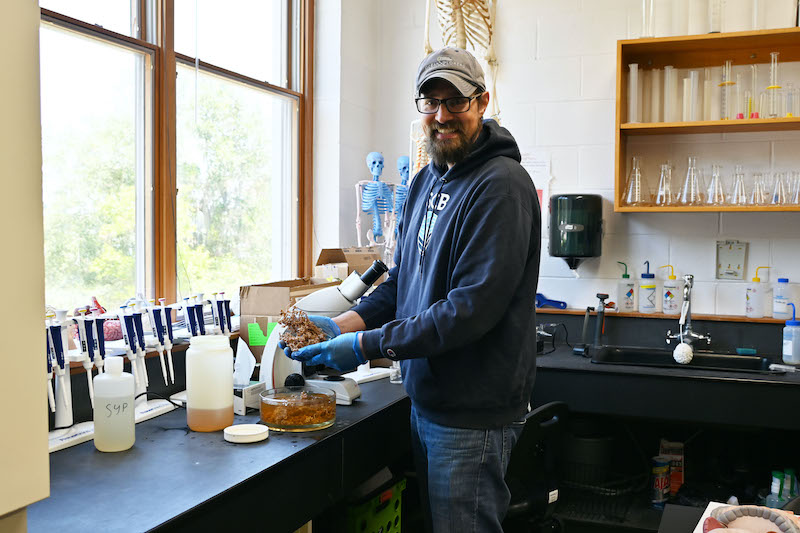
That sense of discovery is something he shares with his students at USCB.
“The way I draw students into the lab is I tell them, ‘I’ve got all these clippings of deep-sea corals in my office that we haven’t analyzed. Many may be new to science,'” Brugler said. “‘If you find one that’s new to science, you get to help name it.'”
Originally from Texas, Brugler discovered his passion for marine biology while scuba diving in the Florida Keys as an undergraduate at the University of Miami. He later earned a master’s degree from the College of Charleston and a doctorate from the University of Louisiana at Lafayette. He completed postdoctoral research at the American Museum of Natural History and taught at New York City College of Technology before joining USCB.
“I knew I wanted to get back to the Lowcountry,” he said. “I saw that USCB was starting a new undergraduate marine biology program, and that’s what I’ve always wanted to do.”
Today, Brugler and his wife, Nicole, are raising 9-year-old twins, Ava and Jax, and 5-year-old Chloe in Beaufort, where family trips to the beach often become impromptu marine biology lessons.
“They’re little marine biologists,” he said. “They pick up everything.”
Brugler believes that for the scientists of the future, the greatest discoveries are still waiting in the unexplored depths of the ocean.
“There are many more species out there that we haven’t discovered yet,” he said.